Saturday, 20 April 2013

The name of wifi..


    The term Wi-Fi, first used commercially in August 1999 was coined by a brand-consulting firm called Interbrand Corporation. The Wi-Fi Alliance had hired Interbrand to determine a name that was "a little catchier than 'IEEE 802.11b Direct Sequence'". Belanger also stated that Interbrand invented Wi-Fi as a play on words with Hi-Fi (high fidelity), and also created the Wi-Fi logo.
The Wi-Fi Alliance initially used the advertising slogan, "The Standard for Wireless Fidelity", for Wi-Fi but later removed the phrase from their marketing. Despite this, some documents from the Alliance dated 2003 and 2004 still contain the term Wireless Fidelity. There was no official statement related to the dropping of the term.
The yin-yang Wi-Fi logo indicates the certification of a product for interoperability.
Non-Wi-Fi technologies intended for fixed points such as Motorola Canopy are usually described as fixed wireless. Alternative wireless technologies include mobile phone standards such as 2G,3G or 4G..

history of wifi


        802.11 technology has its origins in a 1985 ruling by the US Federal Communications Commission that released the ISM band for unlicensed use. In 1991, NCR Corporation with AT&T Corporation invented the precursor to 802.11 intended for use in cashier systems. The first wireless products were under the name WaveLAN.
Vic Hayes has been called the "father of Wi-Fi" by some, due to his involvement in negotiating the initial standards within the IEEE while chairing the workgroup.
A large number of patents by many companies are used in 802.11 standard. In 1992 and 1996, Australian organization CSIRO obtained patents for a method later used in Wi-Fi to "unsmear" the signal. In April 2009, 14 tech companies agreed to pay CSIRO $250 million for infringements on CSIRO patents. This led to Wi-Fi being attributed as an Australian invention, though this has been the subject of some controversy. CSIRO won a further $220 million settlement for Wi-Fi patent infringements in 2012 with global firms in the United States required to pay the CSIRO licensing rights estimated to be worth an additional $1 billion in royalties.
In 1999, the Wi-Fi Alliance was formed as a trade association to hold the Wi-Fi trademark under which most products are sold.
The key technologies behind Wi-Fi were developed by the radioastronomer John O'Sullivan as a by-product in a research project, "a failed experiment to detect exploding mini black holes the size of an atomic particle".

wi-fi


Wi-Fi (also spelled Wifi or WiFi) is a popular technology that allows an electronic device to exchange data wirelessly (using radio waves) over acomputer network, including high-speed Internet connections. The Wi-Fi Alliance defines Wi-Fi as any "wireless local area network (WLAN) products that are based on the Institute of Electrical and Electronics Engineers' (IEEE) 802.11 standards". However, since most modern WLANs are based on these standards, the term "Wi-Fi" is used in general English as a synonym for "WLAN". Only Wi-Fi products that complete Wi-Fi Allianceinteroperability certification testing successfully may use the "Wi-Fi CERTIFIED" trademark.
       
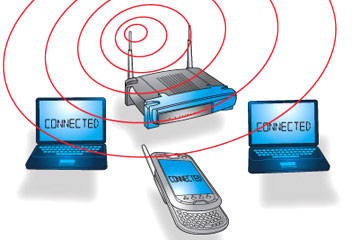
         A device that can use Wi-Fi (such as a personal computer, video-game console, smartphone,digital camera tablet, or digital audio player) can connect to a network resource such as the Internet via a wireless network access point. Such an access point (or hotspot) has a range of about 20 meters (65 feet) indoors and a greater range outdoors. Hotspot coverage can comprise an area as small as a single room with walls that block radio waves or as large as many square miles — this is achieved by using multiple overlapping access points.
Wi-Fi can be less secure than wired connections (such as Ethernet) because an intruder does not need a physical connection. Web pages that useSSL are secure but unencrypted internet access can easily be detected by intruders. Because of this, Wi-Fi has adopted various encryption technologies. The early encryption WEP, proved easy to break. Higher quality protocols (WPA, WPA2) were added later. An optional feature added in 2007, called Wi-Fi Protected Setup (WPS), had a serious flaw that allowed an attacker to recover the router's password. The Wi-Fi Alliance has since updated its test plan and certification program to ensure all newly certified devices resist attacks.